order
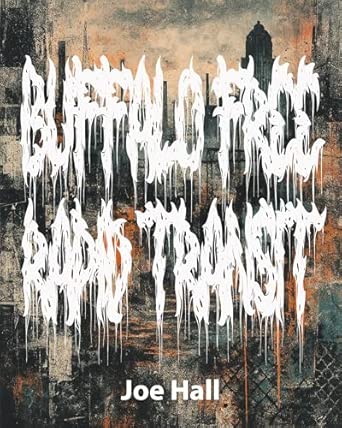
Joe Hall’s intense and unsparing Buffalo Free Rapid Transit combines a darkly observant stroll through a crisis-plagued Rust Belt city with a love letter to the people trying to get by within it. These poems move through the years 2020–2023, when one American city became a recurring site of national horror: a police assault caught on camera, a white supremacist massacre, a blizzard that killed forty-seven people while emergency services failed. Hall grapples with decades of abandonment and disinvestment—and with what it means to keep living, coping, working, and dreaming in a place the rest of the country only notices during disaster. The long, searching lines come from the strange place where cold reality, dread, and visions of a better future crack open into each other.
“Days and nights in the city lowlands of this imperial core work and wear us down so completely that we have no choice but to feel everything. In such a state, in which one cannot escape being sick with the world, Joe Hall’s poetry—which I’ve been reading so long, I’ve grown up with it—is a transit map and, more bracingly, a kind of vengeance. It hews so close to the bone of existence, it chews through it; it drinks the marrow for us, transforming despair into ecstasy for us. It is, in this way, sacrificial. As Hall says, deep in the blazing guts of this book: ‘that’s the job: / touch the ashes / touch and touch / the ashes.’”
— Brandon Shimoda
“Buffalo Free Rapid Transit digs its toes into chemical effluvia & slurring waste to square up to the bad commons & enclosures of the now, asking: ‘what’s a city?’ & what’s to be done when the very infrastructures of state violence share walls with those of care work, when cop infestations, landgrabs & corporate plunder grip & foreclose prospects of life itself? Part insurgent refusal, part radical conjuration, such lines of questioning open into re-purposeful dreaming: in place of capitalist decadence with its henchmen, developers & shimmering rubble, Hall proposes the apiary & shelter without limit.”
— Knar Gavin
order
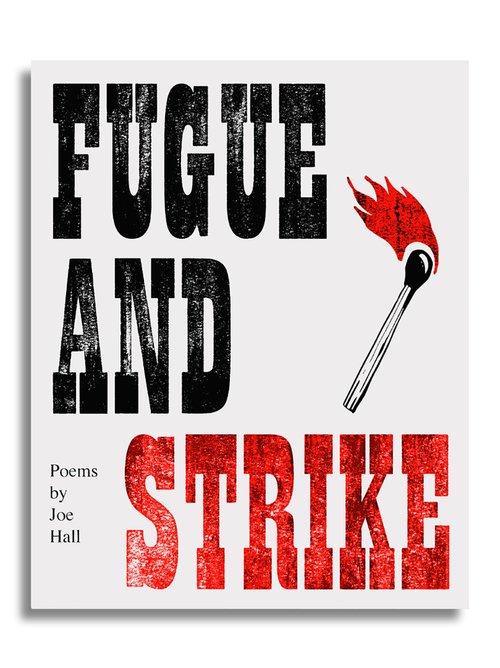
On Fugue & Strike
“Joe Hall’s poems move between a fist-pounding urgency, the fire and squelch of this moment of our endtime, and a vulnerability hushed and gentle as a nightgown on a laundry line.”
“It’s a remarkable poetic project, unlike anything else in literature today.”
“An important volume for our moment of ecological catastrophe.”
“The text contends that there is such a thing as public space, and that the poet can intervene in it. Moreover, it asserts that Buffalo—a poor, working-class city in the Rust Belt, crumbling from decades of neglect—is capable of ecstatic beauty.”
—Alex Scopic, The Cleveland Review of Books
“[Fugue & Strike] places poetry into intimate contact with labor history and enduring labor organizations; and devoting its poems to waste, workers, waste workers, and environments of waste, Fugue and Strike directs us to a confrontation of writing and publishing practices, municipal political action, and the rethinking of our transportation and production systems within a larger ecology.”
“In Fugue & Strike, poetry hovers spectrally above the infrastructures of the capitalist machine, laying bare its circuitry and potential oblivion. A missive smeared in excrement becomes a manifesto. Mutiny is declared against poetic form. Cops and scabs murder each other. In its close examination of the void between labor and commodity, pleasure and oblivion, Hall’s terrifying and often hilarious book envisions ‘a space of public salvage,’ a global common that stretches from Buffalo to Ithaca, to the world. These poems will make you want to strike, fight back, and leave a burning bag of shit on your boss’s doorstep—and for that, we need them. Joe Hall is one of the greatest poets we have.”
— Marty Cain, author of The Prelude
“In the thick of an endless fight for liveable life, Hall presents parallel wastages—both the people made into waste by state and socioeconomic violence, and the excess objects, fragments, sites, and molecules generated by the same violence. The fugue of navigating a breathlessly gentrified, financialized city space leads to a time-hopping study of garbage handlers’ strikes. Words fail, action arises, and somehow, along with it, hope. Any reader sharing this fugue/strike might say, ‘I felt the tip of something I could not see in me that trembles,’ and know that it is not just fear.”
— Jay Besemer, author of Theories of Performance

Joe Hall
W R I T E R | T E A C H E R | R E S E A R C H E R
Writer // Joe Hall is the author of five books of poetry, most recently Fugue & Strike (2023) and Someone’s Utopia (2018). With Chad Hardy, he co-authored The Container Store Vols I & II (2012). With Cheryl Quimba, he co-authored the chapbook May I Softly Walk (2014). His next book, Fugue & Strike, is forthcoming in 2023. Hall has performed and delivered talks nationally at universities, living rooms, squats, and/or rivers in most of the 50 states as well as Canada and Washington, DC. He participates in Hostile Books, a publishing collective dedicated to radical materiality, with Ryan Kaveh Sheldon and Angela Veronica Wong,
Teacher // Hall is currently a Visiting Assistant Professor at St. Bonaventure University. He has taught community based creative writing workshops through the Worker Center in Buffalo and Just Buffalo Literary Center. His college teaching experience includes all levels of undergraduate creative writing and environmental literature. He is frequently amazed by his students.
Researcher // In 2018, Hall received a PhD in Literature from the University at Buffalo, SUNY upon completion of his dissertation on liquid commons in eighteenth-century literature. The Journal of Post Colonial Studies and Eighteenth-Century Fiction have published his articles on literature, water, waste, and imperialism. His essays and reviews have appeared in Annulet, Terrain.org, The Colorado Review, and Fence Digital. His current research project involves settler colonial aesthetics in modern American ecopoetics.
If you or your community is interested in being in conversation with Joe or to follow his work, you can find him at joehalljoehall on Twitter and Instagram and joescirehall / at / g m a i l . com.


