Hey,
Fuck war. Fuck the transnational genocide machine drunk driven by the Epstein Class.
Seriously. That’s what my Ph.D. studies have led me to conclude. Which was an idea one of my first mentors put in my head in far more humane terms. It was 2001—Lucille Clifton in a conversation with Li-Young Lee at St. Mary’s College of Maryland. They talked about Star Trek too. And how a poem needs everything, including wrath, because it will transform it.
Anyway, it’s a mega post.
A lot has been going on since I posted to this certainly mold-problemed blog last.
I had 2 New Poems in HAD.
The Amenia Free Review posted a handful of poems that are part of my new book, Buffalo Free Rapid Transit. I’ve called these poems, maybe not so seriously socialist surrealism. Well, AFR is a socialist avant-garde publication. And I think we need more publications like this willing to wear their politics on their sleeve and which try to explore the aesthetics of that politics in a multifarious way. Now we’re getting somewhere.
I’m burying the lead. Here’s a cover of my new book:
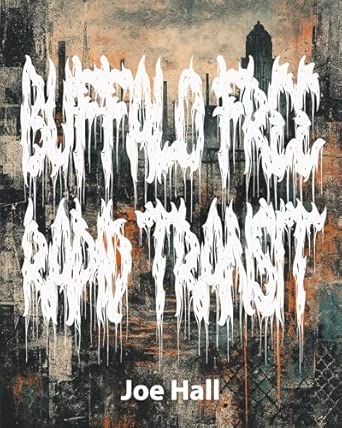
It’s made from love and rage and the shredded trains of an unrealizeable future, angel ligaments, bus rides, friends on bikes, cruel glittering snow, and all the rust and all the sparking haywire power structures of Buffalo.
You can pre-order it from lesser evils. It drops April 7.
Onto this, massively delayed:
January ||| Bo///<<<KS, Articles, Phoneme Tangles ///////// After ICE shot a poet in the face then executed a nurse in the street (echoes, faint – Al-Shifa), it has been hard to sustain attention on anything else. Though the federal ethnic minority pogroms demand attention and action, disaster piles upon disaster each threatening to overshadow the last. Books can bring us back to center; can help us hold two things at once. /|\/|\/|\/|\/|\/|\/|\/|\/|\/|\/|\ I read Sahar Khalifeh’s novel Passage to the Plaza (1990, Eng translation 2020 by Seagull books – India, UK). The socialist-feminist Khalifeh is a giant of Palestinian literature. This is her novel about the first intifada, revolving around the shifting relationships of three women stuck in a “house of ill repute,” inhabited by Nuzha. They’re stuck there because of the Israeli occupation of their city Nablus and resistance to it in that neighborhood. There’s something so remarkable about how Khalifeh writes time under the occupation, with characters undergoing internal revolutions in the spans of hours and days. With conversations interrupted by the violence of occupation. With the security of three women being interrupted by a man with a weapon with unyet known motivations. Where sometimes amongst the exterior world, described with restraint, the writing breaks open into lyric intensity to animate characters’ inner lives. Because she’s a social novelist giving us three different women occupying three really different lanes in society. Through this approach, Khalifeh provides a textured view of women in occupied Palestine; she’s able to pose questions and present tensions and contradictions within her characters and her characters’ worlds while also refusing to both-sides the occupation. Indeed, it’s a novel about people coming across difference and motivations to learn to fight together. I talked to some friends who read it too. They said they were struck how much the scenes of Israeli troops casually bullying Palestinians in the streets reminded them of what they were seeing ICE do in U.S. streets. We talked about the fact that a lot of us are learning to fight together; Minnesota knows how to fight. We also talked about the need to not forget Palestine as things get hotter here but rather strengthen the connections between the two. I’ve struggled on that front a bit lately. Khalifeh brought me back. Her novel The Inheritance is also excellent. /|\/|\/|\/|\/|\/|\/|\/|\/|\/|\/|\ Roberto Bolaño’s Amulet (1999 in Spain under Amuleto, 2006 in English by New Directions). If I weren’t a lazy man, I’d figure out if Amulet is a fragment from the Savage Detectives expandedor if the Savage Detectives incorporated and condensed Amulet into its prismatic-POV framework. There’s literally no way to know (aside from a quick internet search that this lazy man will not interrupt his typing flow to do). A novella told almost entirely from a bathroom at the National Autonomous University of Mexico by the character Auxilio Lacouture, stranded there during the army’s occupation of the campus. As with Savage Detectives, the novella is interested in the shaggy network of poets of Mexico City and its bohemian fringes, the conversational voice swerving into mythologizing and the visionary in ways that seems effortless, though the more romantic ending suggests to me that this was written before Savage Detectives. But, again, there’s no way to know. My friend D, who lived and breathed Mexico city, calls Bolaño the Nirvana of Latin American literature for a certain generation. He was that irresistible gateway to other writers, deeper cuts. I like that. There’s more to say but there’s also work tomorrow. So here we |/////$$$&&&&&$$$//////| go onto Edwin Rolfe: Collected Poems, Edited by Cary Nelson & Jefferson Hendricks. For a too long stretch of my reading life I was dead set on reading what I had decided to read years ago and was just getting around to. Paradise Lost in a file room. An enormous stack of ecopoetics anthologies I wanted to argue with. This or that Marxist’s murky theory brick. What I didn’t do was stop everything to read a book someone handed me. It’s only recently that I’ve been putting these books at the top of my pile to make this reading a more social practice. Which is all to say it took me four years to read this and, having read this, that four years feels four years too long. Rolfe was a militant poet who wrote the majority of his best known work in the 30s and was a member of the Abraham Lincoln Brigade, which fought against the fascists in the Spanish Civil War. It was a particularly (happily) dissonant read for me, with Rolfe’s restrained, even classical style serving as a vehicle for militant, left sentiment. And, well, sometimes you need to read someone who put their money where their mouth was and wasn’t afraid to say it. Here’s a few lines from “Brigades Internacionales”: “To say We were right is not boastful, / nor We saw, when all others were blind / nor We acted, while others ignored or uselessly wept. // We have the right to say this / because in purest truth it is also recorded: We died, while others in cowardice looked on.” Hearing the echoes? Here’s some deep red lines from “Three Who Died”: “those who break our class-foes’ lines / forever live within the heart’s vast kremlin” & “you whose brains are leashed / to a boss’s payroll.” More lines on paralysis in the face of history: “And so we sit in separate rooms, you / intimidated by the silence, vaguely / feeling all’s not well, too tired to read, / too restless to lie still, too stirred / to trace this strangeness to its source.” (from “To My Contemporaries”). A flash of horror, the bombing of Madrid: “The headless body / stands strangely, totters for a second, falls. / The girl speeds screaming through wreckage; her hair is / wilder than torture” (from “City of Anguish”). Here Rolfe expresses his faith that documenting the outrages of the fascists and agonies of the Partisans would serve to purpose: “Yes, tears are futile in our days of grief, / and unreined anger. Nothing more / than the simple enumeration of horrors / is needed—the undying fact.” & love this line on never resting easy, not settling: “Yet I know, in the heart of my heart, that until your liberation / rings through the world of free men near and far / I must wander like an alien everywhere” (from “Elegia”). Rolfe’s romantic solidarity of the Spanish Civil war-era poems turns to something more bitter and disillusioned in his later works as Rolfe sees fascism resurgent in the U.S., his comrades suffering under withering McCarthyite assault. Here’s the concluding stanza in “And If You Don’t See What You Want, Ask for It”: “If you don’t like it here go back where you came from! / The voice was vicious, the tongue was fury. / I tried. But I failed. The border was closed. / Only my father had entry there / with his dual external citizenship. Not I.” Here Rolfe finds lines for being smeared by the state in the press: “His age, description given, his children named, his wife / mentioned profanely, his private habits exposed; / the walls of his few rooms torn wide for all to see, / the walls of his life’s efforts crumbling, broken—.” One//////might think of the federal investigation of Renee ////// Good’s widow, the new drive to label anyone who documents ICE as a terr/////orist. Chilling reverberations over and over reading this collection, perhaps because Rolfe writes it all plain. A pithy mediation on shoot-and-cry from one bird to another “Never mind his eyes, nor his flowing tears. Think of sky, not the earth where the hunter stands. / Don’t pity his weeping. Watch his hands.” That’s a few lines scattered on the surface of this burning pond. The book’s scholarly apparatus is dope. //////////////////////////////////////////////////////////////////////////////////////////////////////////// Her Smoke Rose Up Forever by James Tiptree Jr. (Tachyon Publications, 2004). I wish I had more time to write about this collection of 60s-80s feminist sci-fi short stories and novellas written under the pseudonyms James Tiptree Jr. and Racoona Sheldon by Alice Bradley Sheldon. First, they deliver as page-turning sci-fi narrative. Space ships get crash landed; female protagonists combat with drugged out or horny (or both) or vengeful male spacemen in zero G; laser cannons get fired at enormous lobster-like goliaths whose reproductive patterns threaten to wipe out a colony while the leader of that colony psychically begs a plant-like node being for help. The stories force one to think—yeah—but were also so gripping in plot, pacing, and character that I ploughed through the book. Sheldon can also write some wild New Wave inflected sentences. She uses the affordances of fiction to write some of the most recognizably insecure male characters I can remember. And as you might be picking up, Sheldon is dramatizing through a critical (and sometimes wickedly playful) lens key feminist concerns that can get excised from earlier sci-fi: gender and power; reproduction; colonialism; the cybernetic, etc. Perhaps one thing that gets dramatized across the arc of the stories is feminist hope versus pessimism, utopia and apocalypse. While, ultimately, reads as a skeptic—convincingly, quite often—there are a few blazing exceptions. It’s all more complicated than this; I wish I could unpack specific stories. And talk about Cold Pig! Or the jaw-dropping climax and ending of “Houston, Houston, Do You Read?” Sheldon takes up race, too, but with far more mixed and often poor results. Hardly surprising from a white author.
 JOE HALL