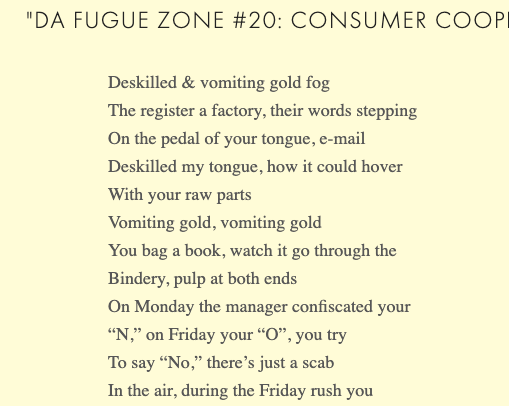
This poem at Best Buds! Collective came from working at a consumer cooperative and very much experiencing that as having just a lot more bosses. The customer is always right and also on your board. Not good. The small college town I was in was a hub for consumer cooperatives. And massively unhappy 20 something employees scraping by, dragging debt around, and getting talked down to by sociology professors. Among these unhappy workers I came to see the difference between the two kinds of cooperatives as differences of kind, not degree. Yet up to a year ago I constantly confused the virtues of one for the other. Then I started vomiting gold.
***
Some of the mission statement of Best Buds! Collective:
Best Buds! Is an anti-capitalist, anti-work queer publishing & design collective. We’re made up of writers, artists, editors, and designers who are explicitly opposed to oppressive & exploitative publishing and production models within the arts.
The mission of Best Buds! is simple: to pool our resources (labor, financial, and experience) in a manner that allows artists to maintain agency over their work. We aim not to curate work that we “select,” but to bring to life projects from artists we believe in: our authors & artists maintain every final decision about the production of their work and are given 100% of royalties on all net profit.
Whereas the members of our collective don’t share any explicit political affiliations, we are opposed to white supremacy, colonialism, corporations, xenophobia, ableism, trans-exclusionary radical feminism, the cishet patriarchy, philanthrocapitalism, intellectual property, imperialism, jingoism, and anti-sex work puritanism. Thus, we disavow just about all major policies practiced by major publishing houses and institutions.
There’s more. They have a spreadsheet of their finances below this mission statement.
YES.
***
Back to my poem, cooperatives. One way forward: a dense web of worker-owned cooperatives. Workers controlling the work place, practicing direct democracy. Worker owned organizations working w/each other, creating circuits of exchange that go beyond currency and level hierarchies of value–a version of the solidarity economy, a culture of cooperatives and democratic control. I look to Cooperation Jackson for this model’s capacity to counter gentrification and massive transfers of wealth from cities to huge, heinous corporations like Amazon. And their model’s emphasis on reducing carbon emissions in the process. And their practice of this vision in a city largely and state entirely hostile to it.
***
Here’s a quote from Milton on the necessity of the 17th Century, English version of impeachment in his 1650 The Tenure of Kings and Magistrates: “Who knows not that the King is a name of dignity and office, not of person: Who therfore kills a King, must kill him while he is a King.” Repeat: “Who therfore kills a King, must kill him while he is a King.” His point is that the English parliamentarians could not bring Charles to justice in hindsight, after he had been effectively relieved of his kingship. It had to be done to Charles, King. You can’t wait for a tyrant to relinquish power. Mobilizing the language of tyranny one has assumed that the tyrant won’t relinquish power. The right has been deploying the language of absolutism. This is the rhetoric that was mobilized in response.
***
reading…Jill Magi’s Speech, Rebel Rank and File, Andrea Abi-Karam’s EXTRATRANSMISSION.
Marriage Story IS JUST PEOPLE YELLING FEELINGS.