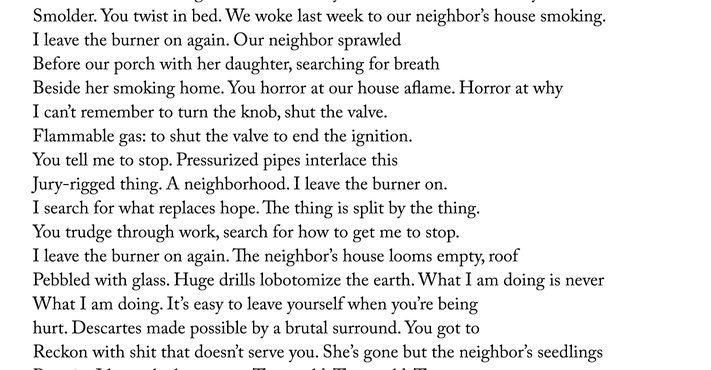
We do our best to be hospitable to poets passing through Buffalo. But we can’t stop the house next to us from catching on fire. Which is a not uncommon occurrence in certain neighborhoods in Buffalo. Old houses, old wires, a few generations of downwardly mobile inhabitants in an emptying neighborhood, deferred maintenance, newer power-sucking appliances, fire. I’ve been in my neighborhood long enough now that I can draw a little map of houses that have burned while I’ve been here. Anyway, it was shortly after we had to wake up a couple poets at 3 AM and tell them the house next door was burning down and we should probably get a safe distance away that I wrote one of the poems Sixth Finch just published.
The other poem could go on forever—it’s love, for C. Twenty years on. Goddamn.
The stalwart independent literary journal Sixth Finch has been going for well over a decade. Thanks to Rob MacDonald for giving these a home, fifteen(???) years after I sent them some f the War on Terror poems they passed on. Sometimes things take a while to fall into place. Just needed the world to fall apart.
Ok, here’s the books I’ve been swimming through in these summer months. It’s a particularly divergent set of texts. Travel and a shattering death of someone close has left me bouncing around, looking for meaning in others’ words.
+++++++++++++++++++++++++++++++++++++++++++++++++++++++++++Bedroom Vowel by Zoe Tuck (Bunny, 2023). Relaxed FOHish sense of line and thought ambling between social, cultural, and philosophical worlds and the quotidian: “Last night I lay on the couch / and watched Jos Charles’s talk / on lyric something-or-other / at the Poetry Project // cravenly jealous of trans / academic stars // even though talking with Zach earlier had made me remember / that I don’t want to be famous, just ‘part of the conversation’ / (I’m not sure why that bit needs scare quotes).” The poems are a good hang; there’s the warmth of a voice and sensibility that’s wickedly smart but sets off in each poem from a place curiosity and thought in process that takes wide turns across the line breaks. “What happens when you punish love? / I would tell you, but I have to go to work.” Yeah, you know it. Looking forward to Zoe’s next book.
+++++++++++++++++++++++++++++++++++++++++++++++++++++++++++Land Keepers edited by Ecorove / Iyad Abou Gaida and Jumanah Abbas (Genderfail 2026). A remarkable collection of essays on the shared ecologies of Southern Lebanon, Palestine, and parts of Syria published just as the entity was waging a campaign of ethnic cleansing—destroying entire villages, assassinating journalists—in Southern Lebanon. It includes transcriptions of field interviews with the villagers in these lands. A slice: “If you really want to love the laurel come here when it is all yellow flowers in bunches. Some trees are male and some are female—this one for example is male because it doesn’t carry berries. In our land there are lots of trees, sindian oak of all types and laurel—but the laurel has dominated everything. // You know if Israel would give people a break this place would be a paradise janna.” It’s both a celebration of these ecologies and the lifeways of those ancestral lifeways that have developed alongside them and an account of the history and techniques of Israeli occupation and ecocide, which have scarred and fragmented these lands and displaced these communities. Read it, already—and act! I tell myself. The soil remembers. The land resists! This book reminds us. And that things like Lebanon’s movements of food sovereignty are acts of “ecological resistance.” Was struck reading this by how subsistence agricultural practices before the occupation and colonial divisions of this ecology provided a common material ground for the people of the region and how the destruction and commodification of the land and the commons becomes a tool for occupation in creating the kinds of power differentials and scarcities that accelerates sectarianization. Here’s to the indigenous peoples of Lebanon, Palestine, and Syria reclaiming sovereignty over their fields, pastures, and groves. +++++++++++++++++++++++++++++++++++++++++++++++++++++++++++ My friend Tim was good friends with Linda Gregg so when a colleague downcycled a copy of the April 2026 Poetry in my direction, I flipped it open and, upon finding a Linda Gregg folio, read it. I enjoyed several of the poems. And reminded why Poetry bugs me so bad. It’s not just the poems, it’s the editorial approach that surgically removes poems from their contexts. The Gregg poems, we’re told, have mostly been selected from her collected poems. Why not provide the original book or journal publication? Why not put them closer to a poet in the churn of biographical and historical time? The biographical notes are largely about her activity—where she was when she wrote what–and writing style. There’s little there about her person or values or politics. Or the interplay of that with what she wrote about and why. Complicated, frustrating, beautiful people are ground down into the worst of all possible things: writers–who write this way or that whose writing this way or that can be compared to other writers who write this way or that in a long somnolent continuum of writers writing this way or that who knows why and to what ends. Merely writers, largely outside of social and political history they lived. Kill me now! +++++++++++++++++++++++++++++++++++++++++++++++++++++++++++
On the other hand, Laura Jaramillo’s poems in the new Cleveland Review of Books (Vol 4.1)are absolute wall-rattling bangers. “Holding,” which condenses the planetary floods and fires (the world begins in flood and will end in fire) to the scale of a house ends here—
what does it mean to
write poetry at the sunset
of literacy
–and it works! Sure, the poem mentions poetry but to ask us to consider it in relation to turmoil the poem so delicately implies. The poem doesn’t enact a platonic shift where the image-symbol starts to leak something we might mistake for the eternal or transcendent or whatever (which is actually just a kind of gentle connotative float among possibilities). No, it condenses all the stuff of the poem into a pointed now that is the now of both the speaker and the reader.
+++++++++++++++++++++++++++++++++++++++++++++++++++++++++++
The Sphinx, Vol 1, Spring 2026, Ed. Rosemary Carroll. A wickedly weird/funny/iconoclastic poetry/art newspaper which oozes Carroll’s punk-feminist sensibility in design and editorial interjections while making room for interviews, biographical sketches [Christina Vega-Westhoff on the recently deceased Wendy Mukluk, reviews “Vaness Dewolf Blows Smoke Up Your Ass with Maximal Style Review of the Possibility of an Island or Horse Girl’s Ascension”, etc. Here’s the first few lines of a piece in a rounded sans-sarif font over a tilted grid of pink lines: “I HATE KATHY ACKER / I HATE HER EVEN MORE / THE MOST / SO I NOT ONLY STOLE FROM HER & HER FRIENDS AND MY FRIENDS LIKE SHE DID / BUT I DECIDED NOT TO CITE HER OR / ANY OTHER ‘FEMINISTS’ IN MY WORK.” More don’t-give-fuck newspapers with a singular editorial vision. I hope The Sphinx runs for a million issues.
+++++++++++++++++++++++++++++++++++++++++++++++++++++++++++
The Ethical Punk: some guidelines on how not be the absolute worst in punk spaces by Nick [zine]. Picked this up at a punk shop in Ithaca—SEED BOMB—that sold things like opaque water bottles with PISS in 2” letters. 36 pages. Not joking around: it’s a thoughtful, detailed punk treatise. Very good.
+++++++++++++++++++++++++++++++++++++++++++++++++++++++++++
Hey, You Asshole by Kyle Seibel (CLASH Books, 2025). This book of 30 or so zig-zagging short stories was put into my hands by a bookseller with a kind of evangelical urgency. There is something special going on here. The stories are impossibly nimble—they fly in 3, 5, 7 page—their voices alive and real. They alchemize the suburban surreal of George Saunder’s worlds and the lyrical fucking up of Denis Johnson’s characters in Jesus’ Son. So, yeah, when other reviews I’ve skimmed say that it blends the absurd and heartfelt that sounds about right. Seibel has an unparalleled ear for voice. But there’s 30 stories and that volume somehow doesn’t expand his range but illustrates its limits, the limits of an emotionally unreflective white guy fuck-up. This should be shorter.
+++++++++++++++++++++++++++++++++++++++++++++++++++++++++++
Icehenge by Kim Stanley Robinson (1984). I can’t stop reading cheap Ace sci-fi paperbacks. The cover is big rectangles of ice on the surface of some airless planet. ICEHENGE! $2 for this weird second novel by who would become, for good and for bad, the 21st century’s pre-eminent cli-fi writer. Novels are often messy tangles of things; the orchestration of this muchness, of this mass of detail, is part of the pleasure. But I’m not so sure KSR pulls it off. The plot? Emma a crack space life support system specialist gets unintentionally embroiled in revolutionary goings-ons, including a revolution on Mars and an attempt by the revolutionaries to escape the solar system for the first time. In part I, Emma chooses the Martian revolution over escape while still aiding the interstellar fleet prepare. And then two increasingly dull sections from the perspectives of first an archeologist and then a historian hundreds of years apart, chasing down the truth of Emma, the revolution, and a mysterious structure on Pluto—ICEHENGE!—that may or may not be connected to Emma and/or the revolutionary jailbreak from the solar system. Here we have what seems like hallmarks of latter-day KSR: hard science, PMC-types debating with each other, a multiple POV structure, ecologies and the limits of sustaining life, and, er, buildings. Other material seems more unique to this novel, particularly the arc of the plot as it starts to spiral around the super-signifier of the Icehenge and different character’s clashing attempts to decipher its meanings. Like all good super-signifiers we find it, by the end, literally hollow, the mysteries of its origins hinted at but never revealed. I couldn’t help but think of Samuel Delany’s full-tilt engagement with post-structuralism in the 80s and wonder if this is more of dalliance for KSR on the way to a more certain relation with fact and less abstract anchors (like climate collapse) for his plots. The strong through-line in his stories seems to be bureaucrats or professionals debating cause and effect and hashing things out through committees or boards or commissions. He’s very interested in the relations/organizational forms of intellectual or political production and has a knack for often making this interesting. But where in his climate novels the stakes are clear (cities, millions of lives, etc), the final movement of the novel suffers from not knowing why it matters how ICEHENGE! is interpreted. And if the second third of the novel writes the terrain of Mars’ canyons with a particular stark clarity, the final third aims for a kind of cosmic lyricism in writing the outer reaches of the solar system that doesn’t quite land. Also, I wonder how KSR now feels about the decision to make the vibey ancient aliens/conspiracy theorist ultimately right. Still, it kept me from falling asleep at 2 AM at forlorn Toledo train station. Thanks for that. Also, Isaac’s rabbit ate half of the rear cover.
+++++++++++++++++++++++++++++++++++++++++++++++++++++++++++
The Drowned World by J.G. Ballard (1962). A solar flare causes insta-climate change and massive global flooding. Our protagonist finds himself completing a scientific survey in the lagoon that London has become while strangely pulled to head South, into the heat and his own certain death. For sci-fi, it’s more interested in the symbolic life of its protagonist and, maybe, Jung, than the mechanics of climate change. Ballard can be a gorgeous writer and there’s something grimly satisfying about our protagonist stopping the salvage of empire and the gaudy signifiers of Western Civ with a few sticks of dynamite. But, damn, the dawn of cli-fi is Turner Diaries level racist. I mean, I can’t think of a any post-WWII fiction that I’ve read that’s been this retrograde. It’d be too exhausting and pointless to catalog every dank facet of it in the novel. Here’s a few notes: We’ve got Edgar Rice Burroughs-ish white man and helpless damsel victimized by a primitive and superstitious dark horde of pirates/wet salvage-workers in the novel’s climax; we’ve got every named black character defined by grotesque and exaggerated physicality; the ecology itself—the jungles creeping over a drowned London—as racialized, described as a “voodoo jungle.” In this way, The Drowned World remains depressingly relevant in how it lays bare the racial anxieties of the white imaginary in a world of rising waters, increasing temperatures, and climate refugees. Can we say that this novel, which self-consciously evokes and sometimes inverts the tropes of British colonial narratives, acts as a sort of bridge toward neo-colonial novels, ones which continue to justify the economic dominance of other countries, in part, by imagining themselves as victims of demographic shifting migration? Our sci-fi reading group was going to explore fascist narrative via Heinlein. Who knew we’d get a taste of it in Ballard?
+++++++++++++++++++++++++++++++++++++++++++++++++++++++++++
Operating Moon by Claire Marie Stancek (Pinsapo Press [CUNY Graduate Center], 2026). A weave/suture of the violence of a surgical birthing joining with the comfort of mother song/nursery rhyme. Deeply researched, precisely made collaged compositions from medical records and folk songs: “a chorus of mothers whose voices sing through mine in ways I cannot fully account for, other than to say they form the conditions of my song.” I thought of the dusky green lullabies Lorca lectured on—warm and melancholy—with RPMs bumped up & ruptured slowly by swelling metallic bubbles, from “Raindark drenched / when rocking I did clutch / my own bleeding / self singing / won’t you be be / my be my” to “cyborg I plug nipples / in to the pain maw / rate your FAQ / of the train I dragged / it dragged we all / drank me dry our wires.”
I’m reminded by the way reproduction is a site of struggle from which people impose their own or collective sensibilities against and within the institutions that engird it. It gets us to think about these points of tension while being remarkably beautiful (and indexical). Finished it on a train, interrupted by an older poet who discovered poet by taking LSD and reading Dylan Thomas in the 60s. He seemed pretty unimpressed that I was a working-ish poet. I get it.
+++++++++++++++++++++++++++++++++++++++++++++++++++++++++++
Freak of Nature by Ry Cook (Choo Choo Press, 2026, 3rd printing). A chap exploring the self-proclaimed aesthetics of cringe in the I-forward autobiographical genderqueer FOH mode that appears desultory—hey come hang out with these thoughts!—and are much more. Cook keeps it real: “Happy Pride I / say to myself net to / the all-gender restroom / in the Starbucks. I used / to chug my pike roast be- / fore the stomach appoint- / ment get the stool sample / kit from the doctor go / to the closest bathroom / blast riot grrrl & birth / cringe from my fuzz ass- / hole like a true chronic punk.” The zig-zag enjambed lines, often cast within a precise 6 syllable frame put into play the funny, profane, and often sometimes tender lines with what the content of the poem can suggest as a ruthless rhythm—time discipline—of making ends meet in a stage of capitalism that leverages access to ‘health’ for worker submission: “but being tired is- / n’t poetic neither / is pulling a double / with hopes of full-time in- / surance. Trust funds are al- / so not poetic nei- / ther is Williamsburg or / dogs in strollers.” The poet, of course, dodges and plunges forward. And I’m looking forward to more from Ry. The chap’s paper light, the title font like a pebbly cursive, the cover riso-ish colors. Bookfairs, readings. It’ll travel.
+++++++++++++++++++++++++++++++++++++++++++++++++++++++++++
Slogans by Kevin Thurston (Lake Rats Dispatch #1 [printed & designed by Chris Fritton]). Linocut & letterpressed cover with meme-y text-picture interior with spreads like “A BILLIONAIRE / WAS NOT / LYNCHED TODAY” printed over a flag. Or a starts and strips sliced up into a Captcha grid titled “Captcha” the flag. This one collapses the distance between fine art printing and disposable internet pixel spray. KT came up in the D.C. Language scene & this has that sense of politicized and also self-effacing irreverence.
+++++++++++++++++++++++++++++++++++++++++++++++++++++++++++
Great Mineral Silence by Emmalea Russo (Sputnik & Fizzle, 2020 [Chapbook]). “i am trying to find fat in everything / email the virtual help desk / semi-seismic revelations in / the laptop glint of ghee and god / everything quiescent about nature / nature when it’s a container / and butter gets struck by a ray / slathering in buter the body / might grant entrance / smooth and servile / into the space god / or you GOD AND/OR YOU / so easily occupy / smoother.”
+++++++++++++++++++++++++++++++++++++++++++++++++++++++++++
Now by Aditi Machado (Sputnik & Fizzle, 2022 [Chapbook]). Fascinating. A long poem whose ecopoetics themselves seem to ferment and bloom into effervescence—addressing a vegetal you in an ecologically energetic landscape—before, then, becoming conscious of itself, from “the radiopassive light drips into // the wills & the vestments / the vulvate ear & flagellate bean” to “the tendency of your eye to abstract from particulars // shapes you deem platonic doubles vision, belabors being // the optics are a bitch.”
+++++++++++++++++++++++++++++++++++++++++++++++++++++++++++
Tripwire 23: Work/Anti-Work. Always exhilarating. And bracing. Formally adventurous, politically fearless. A lot from this issue stuck: Jacqui Germain’s “In which the Talking Heads are Shunned” & “On This Land We All Get Fed.” That one on the market and leftists writers: “At worst, it enlists the leftist artist to construct a bastardized, supervised dissonance tht instead survives, reinforces, and stabilizes the very structures that should be troubled. A dissonance that is decorative, observational, permanently underdeveloped, and loudly commodified” (29). Lotta Thieben’s “Time”; Danny Hayward’s from Wild Mud; & William Rowe’s review of Hayward (lots to think with there).
+++++++++++++++++++++++++++++++++++++++++++++++++++++++++++
orchid tierney’s pedagogies for the planthroposcene (above/ground press, May 2025 [chapbook]). Do I need to recapitulate my admiration for tierney’s work here? Probably not. tierney moves from the strains of environmental melancholy in her previous book to a more effervescent poetics. This one is plant wonder most of the way down and it’s a goddamn delight. Our opening and ending three lines of one: “sunflowers are slow moving cows of the glebe / and gentle observers always facing the south / the light within kin’s basin is brisk and sweet” “there is shared nod between flowers that history is absurd / the temperature of grief is proof / such matters bacteria share like love letters.” Plants keep doing their work through this petropocalypse.
+++++++++++++++++++++++++++++++++++++++++++++++++++++++++++
Assume Nothing by Leanne Franson (Slab-O-Concrete Publications 1997). Autobiographical indy comic from N’s huge book donation. Thanks, N.
+++++++++++++++++++++++++++++++++++++++++++++++++++++++++++
Exiles from a Future Time: The Forging of the Mid-Twentieth-Century Literary Left by Alan M. Wald (The University of North Carolina Press, 2002). It’s under my belt.

