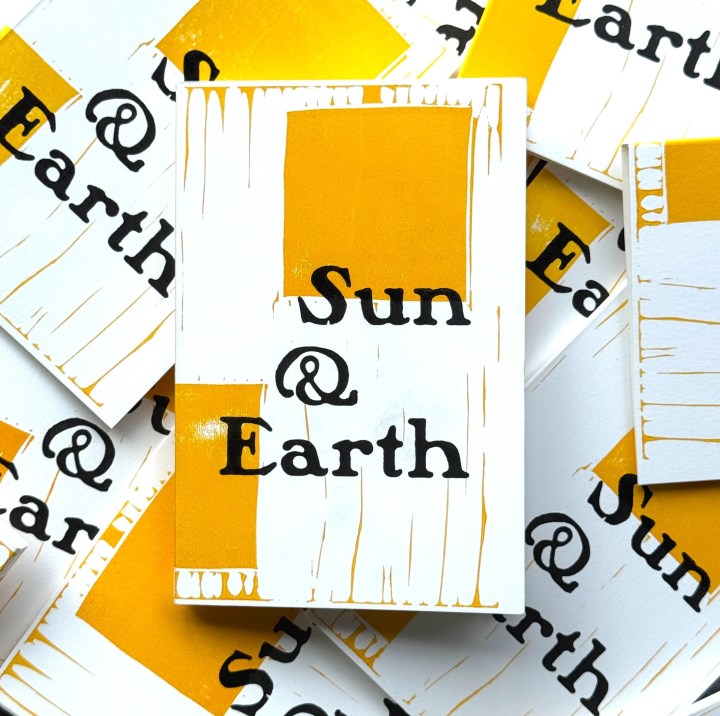
I wrote a little chapbook for Lake Rats Dispatch called Sun & Earth. The first line–“The Sun Is A Terrorist”–for a nation that calls a lot of good things terrorism and makes a lot of bad things law. Lino & letterpress cover. Get it before we’re all gone. All proceeds I get from it will go to the Sameer Project.
PEN America Is Over. Walk Away. Go Home. Do Not Pass Go. No Not Scrounge For Quarters at the G*N0C*dE Laundromat.
There is no justification for working for or publishing with PEN America. I wrote a long essay on this in 2024. Here’s a few thousands more words with the revelation that several members of PEN’s board are connected to the military industrial complex. Thanks to Community Mausoleum for publishing this one.
Aug Read & Received
The Colby Review, Spring 2026 (Ed. Zach Peckham & Many Student Editors). I had a few poems here sent at the invitation of Zach. Highlights include jarring moments of Cary Stough’s linguistic bumpiness; Christine Hume’s “Ultrasound: Seeing Ourselves in Joanne Leonard’s Journal of Miscarriage,” a gripping essay that weaves personal experience, reflection on Leonard’s piece, and research into the contemporary criminalization of miscarriage into a stark re-revelation of the victories of gender-fascists in reass++++++++++++++erting control over women’s bodies while centering the layered experiences of women who are the object of these perverts’ laws; Geoffrey Olsen, from “Five Mountainscapes”: “the legitimate waste / that still follows along / the shipping route, watching / dusk over the last airfield, / at the dust storm over a supply line: / among my continuation floating / as if in the still pool, that / cross check of rusted pipe”; Conor Bracken’s “When People Ask Me Where I’m From”; Samara Cole Doyon’s “Guts of April” (the ending, damn); Rennie Ament’s “DMV”; Zach Savich’s from “Etudes for the Image. Or the Cinder Path” – this one reminds me why I mess around with small press literature – a companion to the hard stuff this summer brought; Alyssa Perry’ “Ham” – ham music! – “Wish I’d studied Fanon and some Shakespeare / Fanon Notley Chaplin Etel Adnan / not lots and lots of iambic meter”; Andrew Judson Stoughton’s deranged “From the Sciences”; Laura Wolf Benziker’s “What About the Skull?.”
RUNTS: David Buuck vs. Sue Denom (self-punish or parrot, Oakland 2006 [chapbook, free]). Hyper-ephemera written as if sniggering in a subway+++++++++++== car at some serious looking dude showily reading Nietzche or Knausgård. Punning throwaways riffing increasingly on themselves—all about escalation and cadence: “APROPOS THE FIVE WORD POEM // THE TWO LINE POEM Doesn’t take long. // TEN WORDS / Is all it took / To finish / This one. // I COULD DO THAT / In, like, eight words.” The spread is used in sneaky ways. & the page turn. Some poems are, uh, crass, keeping some readers from being getting too chummy. Cover papers same as the interiors. It’s exactly what it is. “BIOSLOGANEERING / A bumper sticker crop.”
The Dolphins of Altair by Margaret St. Clair (1967). What if dolphins, after being captured and experimented upon by the U.S. navy, got caught up in an escalatory cycle of military-dolphin violence that climaxed with these dolphins a++++++++9999999nd their human collaborators, setting off psychic-nukes? Those mind bombs are sent to the polar icecaps, flooding the world, partially collapsing civilization, and giving dolphins room to breathe. Which is to say, I did not expect a human holocaust in this slim early entry into modern cli-fi, ecofeminism, and geoengineering, as St. Clair briefly imagines the post-diluvian drowned cities that return in so much modern cli-fi. She writes them stark and unsentimental. Clots of dead bodies. I also expected the novel to revel in the fantasy of humans riding around on dolphins (people have used the premise of dolphin-like aquatic mobility to motivate fanciful writing since at least the 1600s) but this instead kind of sucks for our hu??????????/?man protagonists. Also bracing from the Quaker-adjacent St. Clair is the way she raises the question of the human collaborators’ guilt in helping kill millions of people but then doesn’t dwell on it. Things just sort of got out of hand! Well, at least the dolphins are doing better. It’s an adventure novel; it never stops being one.
As a cherry on top of the relentless weirdness of this one and sincere desire to communicate with an other-than-human species (I didn’t go into the whole dolphins and humans having the same alien ancestors), the novel climaxes in a scene where the dolphins and two human collaborators (species traitors?) combine their psychic energies to have their would be military intelligence captor blow his own brains out. Th&&&&&&&&7&&&en they burn his chopper. There’s a pulpy sense of the nature-culture dialectic here, pushing back against the Cartesian instrumentalist view of nature as a brainless gross matter waiting to be transformed by a higher intelligence. The dolphins are active agents. Attempts to master them incites a response. What’s wild is that St. Clair’s dolphin-human coalition expects eliminatory violence from the U.S. military so they launch a wildly geoengineering attack that kills millions. Is this also a proto eco-fascist narrative around the time deep ecology is gaining ground? On one side of the scale: a few lines about the earth being overpopulated and the narrative framing as necessary smashing up human civilization. On the other: there’s a way to read The Dolphins of Altair as saying well, the real enemy is the U.S. military (using dolphins as test subjects, polluting the biosphere with the radiation of atomic weapons), and if you’re a bunch of dolphins without attack helicopters, the only way to win is to use your mind-nukes to collapse the civilization that undergirds that military. A depressing read, if it didn’t so originally pile on wild premise after premise.
MC Hyland’s The End (Sidebrow Books, Portland, OR: 2019). “In the city where I live residence in a tall building may indicate wealth or s6^6666^^uccess. Young people go there. As in the bathroom the toilet the loo. I regret every use of the word actually but this one most of all.” “I have been watching the dead send greetings to the dead. This is called study. Having abruptly ended the night in the bar and take a set of blurry photos through a bus window.”
Zach Savich’s Études for the Image or the Cinder Path (Salon Des Refusés, 2026). “Tell yourself the remembering itself is good. The difficulty.” A spare feeling 67 pages where the death of Savich’s sisters sends him back to reexamine the facets of poetry. It’s an elegy through reflections on poetics. It’s a poetics where grief glows through the sometimes hairline gaps. Not sure I’ve read anything like it but feel like I received it at t~~~~~~~~~~~~~~he right time, reckoning with the sudden death of my father. So how do you write through that? Savich’s approach may seem idiosyncratic, given how little his sister appears, but it preserves an essential privacy that might be about the speaker but also might be about his sister; it also relates loves. A death of someone we love, that has run parallel to our own whole life, can make us rethink the biggest things down to the foundations. Found it moving and convincing that it sends Savich to the art itself, its forms.
Four Ways to Die in the Future, Short games by P.H. Lee, with Aura Belle (Tao Games, 2022). A gift from a friend. Short, meditate gam|||||||es that bring their players in relations to death—of one’s self, of the planet, of others. Can I say I was afraid to play these games right now?
Songs of Summer (fig press, 2026). Little musical jewel. In string bound lemon covered quadregesimo-octavo form, I think. Back of House by Person# 27863484 [Tim McPeek] (Black Monk, 2026). A handful of poems on working at university food services for 20+ years, growing old doing that. Routine, p***************angs: “Denim UB cap. Nametag. / Hey jon. Hey mary. / What’s up, michelle? / Hey john, how’s the leg?” Gorgeous hand-painted cover, throwing off light bronze and copper. Going to an honored place on my shelf of labor lit.
How To See Like a Machine: Images After AI by Trevor Paglen (Verso, 2026). Was invited to read this in conversation with someone. I read it but the conversation never happened. Which may be just as well as I think we’ve all been forced to think about much of what Paglen is saying as AI gets shotgunned into our software and Flock cameras shotgunned into our communities. Much of it reads as common sense, though there’s a few chewy moments I might drift back to when thinking through digital architectures of oppression: “The overall effect is a society that amplifies diversity (or , rather, a diversity of metad$$$$$$$$$$ata signatures) but does so precisely because the differentiations in metadata signatures create inroads for the capitalization and policing of everyday life. / Machine-machine systems are extraordinarily intimate instruments of power that operate through an aesthetics and idealogy of objectivity, but the categories they employ are designed to reify the forms of power that those systems are set up to serve. As such, the machine-machine landscape forms a kind of hyper-ideology that is especially pernicious precisely because it makes claims to objectivity and equality.”
Perfume: The Story of a Murder by Patrick Suskind (1985). In teacher mode, hunting for olfactory descriptions. There are extensive olfactory descriptions. And a misanthropic protagonist and aloof narrator, which both bugged the sh!!!!!!!!!!!!!!it out of me and kept the pages turning, which I suppose was the point.
Rising for Palestine: Africans in Solidarity for Decolonisation & Liberation, ed. by Raouf Farrah & Suraya Dadoo (Pluto Press, 2026). Absolutely necessary reading. So much to say, bu###########t I’ll just leave this here: “when solidarity becomes transnational, popular, and mobile, it exposes the mechanisms of alliance, surveillance, and fear” (159) – Raouf Farrah.
Cry Perfume by Sadie Dupuis (Black Ocean, 2022). “It’s final boss after boss / after boss after boss / until someday you scratch / my scalp, pet my ponytail, / tuck me in forcibly / hire me to sleep,” fro((((((((((((((m “Brain Shank.”

