comment 0

some thoughts on poetry from someone in 1965 imagining what poetry would be on a post-apocalyptic planet at the end of war whose enemy was imaginary but whose casualties were real

I’ve been falling asleep to Delaney for about six months. Hoping it will irrigate my dreams. And also looking for poetics in unexpected places. Like out of the mouths of characters in a science fiction novel. These are some of my favorite poems, I think. The ones that move characters but whose actual words remain submerged. Anyway, here are some thoughts on poetry from someone in 1965 imagining what poetry would be on a post-apocalyptic planet at the end of war whose enemy was imaginary but whose casualties were real: “A poet is wounded into speech, and he examines these wounds meticulously, to discover how to heal them. The bad poet harangues at the pain and yowls at the weapons that lacerate him; the great poet explores the inflamed lips of ruined flesh with ice-covered fingers, glittering and precise; but ultimately their poem is the echoing, dual voice reporting the damage” – Vol Nonik, City of a Thousand Suns (1965) // “They were very lucid, very clear—and put wild and dispersed matter into a verberating order that came very close to me” (126-7). Clea on Vol’s poems.  //  Kocik, Robert: “When words mean only what they say, we die” (293) Supple Science (2013).  // This was Delaney at 22 // Need some new statements of poetics, I think. And to return to those that matter to me as I mend another book. Not the poem but propositions about how poems might unfold. What’s new?

comment 0
Reading in Denver / Death Horse 13

I’m performing in Denver this Saturday w/some rad folks at Death Horse 13.

Death Horse 13.

Here’s some details:

The Time: Saturday, 5/18/19, 6-8 p.m.

The Place: Bar Max, 2412 E Colfax Ave, Denver, CO 80206

Kate Colby is the author of seven books of poetry, most recently The Arrangements (Four Way Books, 2018). Dream of the Trenches, a book of critical poem-essays, is just out with Noemi Press. Fruitlands won the Norma Farber First Book Award from the Poetry Society of America in 2007. She has also received awards and fellowships from the Rhode Island State Council for the Arts, the Dodd Research Center at University of Connecticut, and Harvard’s Woodberry Poetry Room, where she was the 2017-2018 Creative Fellow. Her work has been featured at the Beauport Sleeper-McCann, deCordova, Isabella Stewart Gardner and RISD museums, and her poems and essays have recently appeared in A Public Space, The Awl, Bennington Review, Boston Review, Columbia Poetry Review, PEN America, Verse and the DIA Readings in Contemporary Poetry Anthology. She was a founding board member of the Gloucester Writers Center in Massachusetts, where she now serves on the advisory board. Colby was born in Boston, grew up in Massachusetts and currently lives in Providence, where she teaches poetry at Brown University.

Joe Hall is a writer, teacher, and researcher in Buffalo and Ithaca, New York. Joe has authored three collections of poetry: Someone’s Utopia, The Devotional Poems, and Pigafetta Is My Wife (Black Ocean 2013 & 2010). With Chad Hardy, he co-authored The Container Store Vols I & II (SpringGun 2012). With Cheryl Quimba, he co-authored May I Softly Walk (Poetry Crush 2014). With Ryan Kaveh Sheldon and Angela Veronica Wong, he participates in Hostile Books, a publishing collective dedicated to radical materiality. His poems have been translated into Dutch and he has done readings at universities, bars, squats and rivers in most of the 50 states as well as Canada and Washington, DC. Hall has taught community based creative writing workshops through the Worker Center in Buffalo and Just Buffalo Literary Center. Joyous Shrub 666, a 3 piece surf punk outfit, tolerates his bass playing.

Thirii Myo Kyaw Myint is the author of the lyric novel The End of Peril, the End of Enmity, the End of Strife, a Haven (Noem Press, 2018) and the family history project Zat Lun, which won the 2018 Graywolf Press Nonfiction Prize and is forthcoming from Graywolf Press in 2021. She is completing a Ph.D. in creative writing at the University of Denver and will be teaching at Amherst College in the fall as a visiting writer.

comment 0

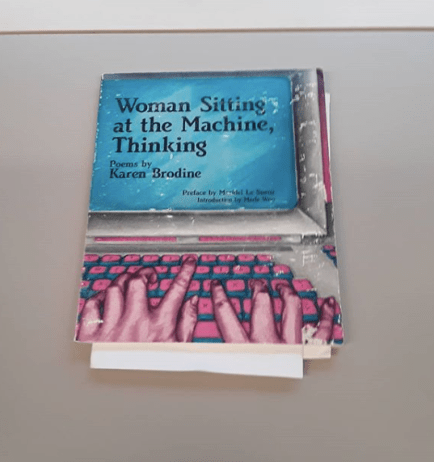
Woman Sitting at the Machine, Thinking

Screen Shot 2019-04-23 at 8.31.44 AM

Couldn’t lv this book more. // “a typesetter changes man to person / will they catch her” (17) // “she thinks about everything at once without making a mistake” / yes! / “the layers, fossils. the idea that this machine she controls / is simply layers of human workhours frozen in steel, tangled / in tiny circuits, blinking out through lights like hot, red eyes.” // “All my life, the urgency to speak, the pull toward silence.” CA Conrad says they fled the factory to save themselves then after years of writing found the factory on their desk. Brodine’s poetics shows how to do more than describe work, she engages it, subverts it sometimes –by imagining bosses are elephants, changing the words it’s her job to typeset, imagining fish in darkness glowing their own light. By centering relationships and solidarities. The poems travel, interrupt themselves w/the coordinated scripts of a job: “this set of codes slips through my hands, a / loose grid of shadows with big gaps my own thoughts sneak / through.” Scribe beside the text. As I spent a long time not critically examining the university, I didn’t think much of the people behind the type, what means and social relations of production a mass-market book requires, what oppressions and resistances. Brodine imagining pounding on the pebbled glass of a supervisor’s window. He could I not love this book for writing printing work w/integrity, having worked at an industrial printing press, having printers on both sides of the family. I’ve seen the title poem get pulled into a couple of anthologies as a great piece of labor poetry but that long sequence is ideally read in full and the threads followed through the rest of the book which moves to the other overlapping spheres of Brodine’s life, her activism, family, gender, sexuality, illness. I struggle with labor poetry when it atomizes people into workers as workplaces do. It reduces their identities; it’s gotta be Labor+ poetry. WSatMT giving space to the wide sweep of Brodine’s thoughts and vibrancy of other quarters of her life. It never feels as if Brodine searches for her subjects, is what’s happening to her, her days—a thermos of coffee, helping clean out her grandmother’s home, getting pulled over w/friends by cops, having a breast removed to stop the spread of cancer. A whole life. // “Survival is a repetitive process.”

Introductions and prefaces usually make me want to puke. This is an exception. From Meridel Le Sueur’s compact, raw intro: “As a poet wounded in my time…driven down into the pits.” Le Sueur does seem like one of those great feminist-labor writers overshadowed when the wave of leftist writing broke in the 40s.

Also read the excellent microchips for millions by Janice Lobo Sapigao and Excess—The Factory by Leslie Kaplan (and in one of those strange twists that almost never happens in the diffuse world of poetry readership and my own hermitship, talked to Laura Marris about her reading and review of Excess–the Factory). Together, these books make me wonder what we could call labor poetry now; who is saying what about feminist, queer, & anti-racist labor poetry; its possibilities and pitfalls in this moment. Some research questions.