comments 2

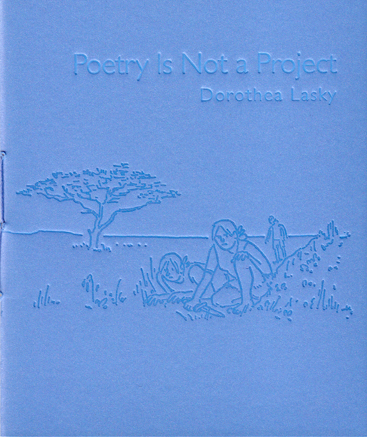
Late on Everything: Poetry Is Not a Project &, What the Hell, More Piling on Hoagland

I want this century to be full of people who write poems, not full of poets who conduct projects and do nothing more.

There is plenty to disagree with in Dorothea Lasky’s pocketable manifesto from UDP. And that is its virtue. This is a canny invitation to talk about intention, process,  and quality in poetry. An invitation through Lasky’s direct, open language and the brevity of the pamphlet itself (14 quarter pages). Lasky isn’t riveting together the panels of an iron clad case or qualifying her points into nothing through academic speak. And for these reasons this should be required reading (in the imaginary classrooms that float in the interstitial tissue of the poetic collective consciousnesses or something like that)  for anyone trying to sort out what they’re doing through poems.

(In many ways, its directness is echoed in Claudia Rankine’s talk on Tony Hoagland’s awful poem. A directness which eventually became lost in the equivocating of the ensuing debate. (Hoagland’s poems aren’t exactly racist. But they’re also not dramatic monologues as his apologists claim. They fail the test because they are not dramatic. The speaker (Uncle Tony) is who we think he is–a reactionary affirming his own limited world view in a moment disguised as epiphany. TRIPLE SIDENOTE: A friend of mine took his HS English class to hear TH read at the Folger Shakespeare Library. The sizeable African American bloc was upset after each one of Hoagland’s poems that came anywhere close to race. My buddy had to apologize profusely for putting them through the Hoagland reading and swear that it was not representative of contemporary poetry. You see, my friend’s students knew, clearly, that they were not Hoagland’s audience. He made them out as aliens from the  Shakespearean stage (the same place David Wojahn ranted about the terrible vices of young poets).  This is what happens when you write for the “general” (white, middle-class, middle of the road liberal, male) reader.)

Anyway, what do I think of what Lasky says? The easy misreading is that she is attacking “conceptual poetry,” yet she praises flarf and uses as her example a serial ekphrastic project, which is the go to for more traditional poets when they want to write beyond the lyric narrative or birds or whatev.  So clearly she is defining “project” in a rather expansive sense.

What strikes me as critical (and what I’d love to hear back from by you) is this:

If a project does not get to a real poem, then it is not that important to your work because it generates nothing. The problem I am pointing out in this pamphlet is that just because you have constructed a project does not mean you have written a poem. You can plan a party, but you have to make the people show up for it to really be a party. Any other way, all you have created is just a decorated empty room.

Is this to say, the writing process dictated by the concept must leave room for the poet to exercise their powers of intuition and the outcomes of this intuitive act must be successful (successful? significant?)–that it is vital for us as readers to pay close attention, above all, to these intuitive leaps, to have a stake in them–to be thrilled or disappointed by their outcomes? Is this the difference between pleasurable engagement and pleasing contemplation? Either way, it is right and good to affirm one’s own prerogative to hate and love what is going on in a poem.

I love these four ridiculously classic lines from H.D.

why must you recall

the white fire of unnumbered stars

rather than the single taper

burning in an onyx jar

It is good and right to hate Hoagland’s poem (above). And the one that frowns in the direction of hip-hop. (No big risks there). And isn’t hate or intense dislike a sort of compliment in and of itself?

Either way, what is ultimately provocative is the call for a return to engagement with a how a poet puts a singular poem together as opposed to critical discourse’s obsession over the principles which inform how certain groups make poems.  It is also a call to party, hard.  I can get on board with that even as I finish up with my buddy Chad something that can only be described as a “project” about The Container Store. In particular, I’d like to think that the damning “and do nothing more” of the first quote extends to both the interior of the poem and the exterior reaches of the poets life. What they do in the world beyond conducting projects. I’d like to think the moments of intuition in a poem are only made possible via an intuitive/intentional engagement with the exterior world–one’s social praxis. (So hey, what does DL mean by ‘Habitus’? I’m not clear on this). So perhaps there are “projecty” types of procedures such as C.A. Conrads somatic experiments that dispose one toward attending to the interiors of one’s work?

Wait, have I gotten to the end of a blog post again without really saying anything? Dammit.

I’ll never be a good blogger because I have no real opinions.

Read Poetry Is Not A Project, ok?
comment 0

On Being Dissected

Jeremiah Gould is currently posting lines from my first book on his Twitter feed as part of his Line Collector Project. He describes it like this:

Line collector is a new project working in conjunction with Poem Projector to expand on authors I enjoy. Each Line Collector is a week-long twitter feed comprised of selected lines from the author’s work. Feel free to follow @LineCollector or check the Line Collector section on my blog sidebar.

He has also performed my work through Poetry Projector.

How does it feel to be dissected, taken out of context, and offered like a piece of meat on a toothpick in a food court next to trivia such as “I made kimchi fried rice for dinner” & “I can’t clip my toenails accurately”?

It feels weird. I want to protect my lines, control them, make their context the context of the book itself.  Some of them are pretty and with flowers. What if people think I’m just a pretty flowers poet? I mean, what is a line and what can it really do? Is there a line of poetry, 2 lines, that can stop you in your tracks? I am curious about this. Would or should you tweet them?

Given that Twitter is such a place of cursory attention, I wonder if it really is the ideal place for poetry which we like to imagine demands sustained attention. Instead it is part of a scrolling wallpaper that looks like this:

Annie was an orphan because she was a filthy, disgusting, ginger child who wouldn’t stop singing.

Run! Toxic thoughts are infectious.

My worst nightmares don’t sleep. #notsixwords

“what I thought was a mirror / was a lead window”@JoeScireHall #poetry #lines #JoeHall

Have you read Stranger Will? Don’t forget about Charactered Pieces on Kindle amzn.to/CPkindle and Nook bit.ly/gtE6nT.

Josh Yospyn on Borf’s overlooked Fridge show, “Potty-Trained at Gunpoint” from last September. http://bit.ly/iToOTt

Fowler shits on Obreht’s Orange – http://htmlgiant.com/?p=67646

Kill me. I am different. #notsixwords

In one light, the lines have become part of a longer, associative collective poem that I can only read once and will probably not read closely ever. But it is there, taking its place amid the collective  effluvium, leveled and raised. And in a way, he’s bringing lines which mean less and less every time I read them back to life. Activating in them things that were hidden to myself. That’s pretty great.

In another light, is it just another bump in the endless circle of social media bumps? A tweet enters a  sort of market where people build social capital in strange diffuse ways.  And a lot of things are making me cynical in regard to the twitter feed, distrustful of the things people say they like or recommend (except you, if you’re reading this!). Have they really read, engaged with it? Whatever motivations might they have to signifying their approval or displeasure? When will we reach a tipping point between seeing an organic feed and a feed whose contents are the product of planning, strategy, etc? In many ways, we are already living in the era of Tweet-ola.

Or is living in the suburbs just making me become a paranoid a-hole? (Baltimore soon–not soon enough!)

In the end though, I’m glad Jeremiah is doing what he’s doing. At the very least it is flattering. More than that, its bracing to be reminded of the fact that my work is no longer my own. It can be pulled apart and reconstituted into some greater glorious architecture/dogfood. And maybe the best way to invite engagement with something (and also with oneself as a lover of things) is to put it out there. Poetry is one of the few things that you can tweet, and the selection of a few lines in and of itself is an act of attention and care. So thank you, Jeremiah.


comment 0

Youth Movement: Bohinc, Marston, Liva, Fools this Thurs @ Cheryl’s Gone

June 16, 2011 – 8pm
Cheryl’s Gone presents…

Adam Marston (poetry)
Christina Liva  (fiction)
Katy Bohinc (poetry)
& Mercury Fools the Alchemist (music)

@ Big Bear Cafe
1st and R NW
Washington, DC

Adam Marston enjoys overpowering his mouth and nasal cavities by eating Dijon mustard made with white wine on pepper jack cheese and wasabi almonds, and then bleaching the taste with mouthfuls of grapefruit juice. Video games are cool. Gucci Mane is cool. Poetry is cool. Fiction is cool. He wants to start a blog of some kind. Podcasts are cool.

Christina Liva is a short fiction writer and ex-urbanite currently taking refuge on a small farm in Virginia. She holds a B.A. in literature from Georgetown University.
Katy Bohinc studied mathematics and comparative literature (french, english & mandarin) at Georgetown University. She is working on a manuscript.

Mercury Fools the Alchemist is “Chamber psychedelia” from a trio: avant classical bass (Daniel Barbiero of Nine Strings, Mindbreath Trio, etc), ambient guitar (Rich Sheehe of Field Shaman), and a homemade “stone age synthesizer” dubbed the “springamajig” (Jeff Bagato, aka Tone Ghosting) produces chimerical cacaphony for mystical journeys.

FB Invite Here.